
Why Do People Pleasers Feel Guilty Saying No? (And How to Finally Stop)
Jun 15, 2026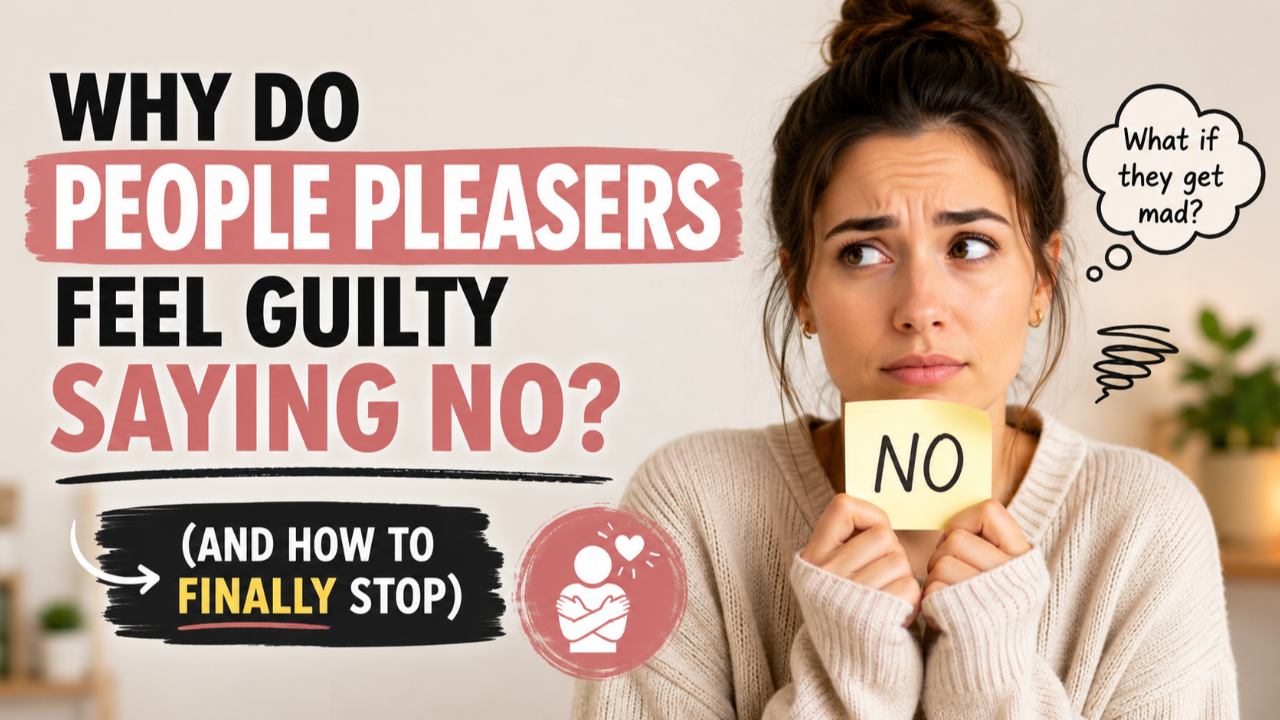
Why Do People Pleasers Feel Guilty Saying No? (And How to Finally Stop)
If you feel guilty every time you say no, here is the truth: you do not have a boundaries problem. You have a disappointment problem. And once you understand the difference, saying no gets so much easier.
Let me explain what is really going on, and what to do about it.
5 Signs You're a People Pleaser Who Can't Say No
If you're not sure whether this is you, see how many of these feel familiar.
- You say yes before you've even checked what you want. The answer is out of your mouth before you've had a chance to ask yourself if you actually have the time, energy, or desire.
- You apologize when you've done nothing wrong. Sorry has become a reflex, a way to smooth the air before anyone could possibly be upset with you.
- You replay conversations for hours. Long after it's over, you're still scanning for the moment you might have said the wrong thing or let someone down.
- The second someone is disappointed in you, something in your chest tightens. Their reaction lands in your body like an alarm, and every part of you wants to fix it.
- You set the boundary, then take it back the moment they react. You finally say the honest thing, and then the guilt rises and you soften it, explain it, or undo it completely.
If you recognized yourself in even a few of these, you're not doing anything wrong. You learned to read the room before you learned to read yourself. The good news is that can change.
If this sounds familiar, The Unlived Life is a 5-day experience to help you catch these moments sooner, before guilt, habit, or someone else’s reaction takes over.
Join The Unlived Life
Why Do I Feel Guilty Saying No?
You feel guilty saying no because somewhere along the way, you learned that someone else's disappointment was your responsibility to prevent.
So when you say no and someone is unhappy, your whole body reacts like you did something wrong. The guilt floods in. You start replaying it. You feel the urge to explain yourself, fix it, or take the no back entirely.
But here is what most people get wrong about this. The guilt is not a sign that you made a mistake. It is simply the feeling of breaking an old pattern. Guilt is a feeling, not a command. It does not have to make your decisions for you.
Is It a Boundaries Problem or Something Else?
Most people think they need stronger boundaries. They read the books, learn the scripts, and still freeze the moment someone asks them for something.
That is because the boundary was never the hard part.
The hard part is what happens after. The guilt. The overthinking. The fear that someone is upset with you now.
You do not struggle to know what to say. You struggle to believe you will still be okay if someone is disappointed in you. That is a disappointment problem, not a boundaries problem. And they are not the same thing.
Why Do People Pleasers Struggle to Say No?
People pleasers struggle to say no because the pattern usually started in childhood, long before you could choose it.
Many of us learned, without anyone ever saying it out loud, that being good meant being easy. Helpful. Not asking for too much. Keeping the peace. Making sure everyone else was okay first.
It may have helped you feel loved, safe, or needed. It made you the dependable one. The strong one. The person everyone counts on.
But it came with a quiet cost. Over time, you became so focused on everyone else's needs that you lost touch with your own. You stopped asking what you wanted. You stopped noticing when you were tired. You got so good at reading everyone else's feelings that you forgot how to feel your own.
How Do I Say No Without Feeling Guilty?
You learn to say no without guilt by understanding one simple truth: you can be caring and still say no.
You can be kind and still choose your own direction. You can love the people in your life and still belong to yourself. These are not opposites.
Here are three things to remember the next time guilt shows up after you say no.
Your no is not unkind. It is simply you being honest about your own direction.
Someone's disappointment is not proof you did something wrong. It is just their feeling, and their feelings are allowed to exist without becoming your responsibility.
The guilt will pass. It is the feeling of a new pattern forming, and you will still be okay on the other side of it.
A Simple Way to Practice Saying No
One of the gentlest ways to start is to let your body feel what it is like to honor your own direction, before you are ever in the hard moment.
Want to practice this in real life? Inside The Unlived Life, you’ll spend five days noticing the small moments when you automatically move past yourself, and learning to catch them sooner.
Start The 5-Day Experience
You Are Allowed to Say No
You are allowed to take up space. You are allowed to put yourself first sometimes. And you are allowed to say no, even when someone is disappointed.
You do not have to abandon yourself to be a good person. The people who love you do not need you to disappear. They just need you.
With love,
Cassidy💚